- Home
Edition
Africa Australia Brasil Canada Canada (français) España Europe France Global Indonesia New Zealand United Kingdom United States Edition:
Global
Edition:
Global
- Africa
- Australia
- Brasil
- Canada
- Canada (français)
- España
- Europe
- France
- Indonesia
- New Zealand
- United Kingdom
- United States
Academic rigour, journalistic flair
Fossil science owes a debt to indigenous knowledge: Lesotho missionary’s notes tell the story
Published: December 9, 2025 1.34pm GMT
Julien Benoit, University of the Witwatersrand, Charles Helm, Nelson Mandela University, Emese M Bordy, University of Cape Town
Authors
-
 Julien Benoit
Associate professor in Vertebrate Palaeontology, University of the Witwatersrand
-
Charles Helm
Research Associate, African Centre for Coastal Palaeoscience, Nelson Mandela University
-
Emese M Bordy
Professor in Geological Sciences, University of Cape Town
Disclosure statement
Julien Benoit receives funding from DSTI-NRF GENUS (Centre of Excellence in Palaeosciences) and African Origins Platform.
Emese M Bordy receives funding from DSTI-NRF GENUS (Centre of Excellence in Palaeosciences). www.genus.africa
Charles Helm does not work for, consult, own shares in or receive funding from any company or organisation that would benefit from this article, and has disclosed no relevant affiliations beyond their academic appointment.
Partners

Nelson Mandela University provides support as an endorsing partner of The Conversation AFRICA.
University of the Witwatersrand provides support as a hosting partner of The Conversation AFRICA.
University of Cape Town provides funding as a partner of The Conversation AFRICA.
View all partners
DOI
https://doi.org/10.64628/AAJ.rfvn44hjh
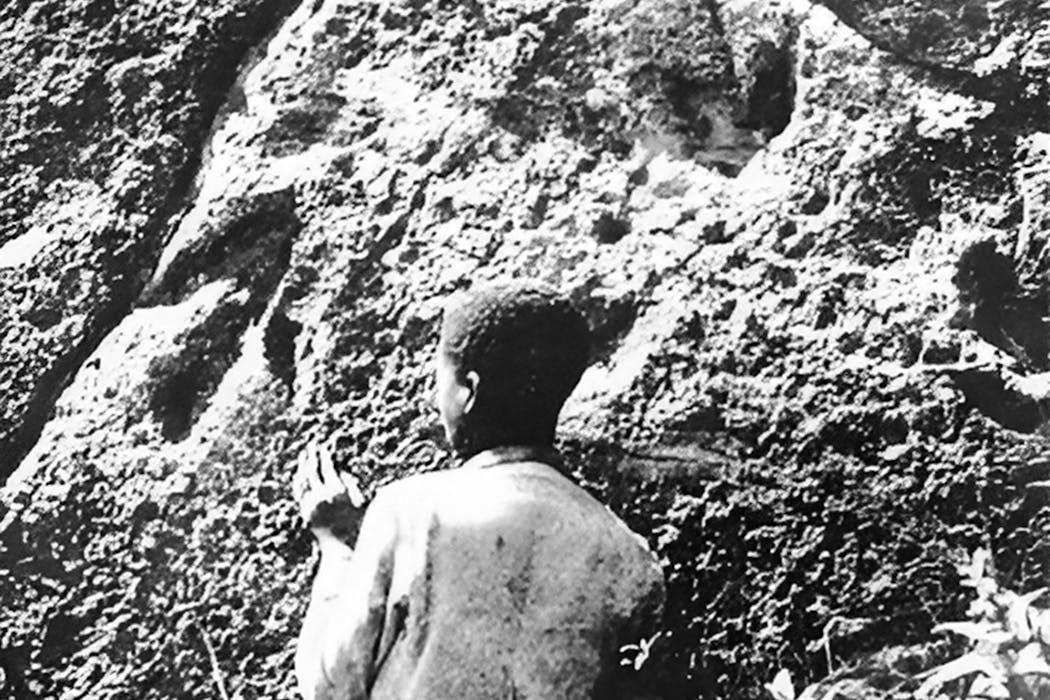
 Dinosaur footprints at Morija, Lesotho, in 1906. The person standing in front of the rock slab covered with tridactyl fossil footprints is not identified.
Photos courtesy of the Institut des Sciences de l’Evolution of the University of Montpellier, France , CC BY-NC-SA
https://theconversation.com/fossil-science-owes-a-debt-to-indigenous-knowledge-lesotho-missionarys-notes-tell-the-story-270431
https://theconversation.com/fossil-science-owes-a-debt-to-indigenous-knowledge-lesotho-missionarys-notes-tell-the-story-270431
Link copied
Share article
Dinosaur footprints at Morija, Lesotho, in 1906. The person standing in front of the rock slab covered with tridactyl fossil footprints is not identified.
Photos courtesy of the Institut des Sciences de l’Evolution of the University of Montpellier, France , CC BY-NC-SA
https://theconversation.com/fossil-science-owes-a-debt-to-indigenous-knowledge-lesotho-missionarys-notes-tell-the-story-270431
https://theconversation.com/fossil-science-owes-a-debt-to-indigenous-knowledge-lesotho-missionarys-notes-tell-the-story-270431
Link copied
Share article
Share article
Copy link Email Bluesky Facebook WhatsApp Messenger LinkedIn X (Twitter)Print article
For over a century, the scientific literature has credited western missionaries with “discovering” fossils in Lesotho, the small, mountainous country surrounded by South Africa.
The narrative typically begins with figures like the French missionary Hermann Dieterlen, who, in 1885, reported unusual “petrified bird tracks” near the settlement of Morija. This account implies that earth sciences like the study of rocks and fossils arrived in Lesotho from Europe.
In contrast, our research supports the notion that the local people recognised, interpreted and explained these fossils before missionaries arrived. Our research focus is on the dinosaur bones and tracks of Lesotho, its geomythology (cultural explanations of geological phenomena), and indigenous palaeontology.
Our recent study revisits the private archives of French missionary and self-taught palaeontologist Paul Ellenberger (1919–2016). He lived in Lesotho from 1953 to 1970 as part of a three-generation missionary family. During this period, he documented various fossils and published his findings in scientific literature. After returning to France, he earned a PhD in palaeontology in the mid-1970s. His contributions laid the foundation for the study of animal fossil tracks and traces in southern Africa.
His notes reveal that the Basotho and San people in Lesotho not only noticed fossils but also integrated them into their culture as geomyths.
This matters beyond Lesotho. Scientific history has often portrayed African indigenous communities as passive background figures. Fossils were deemed “discovered” only when Europeans documented them, despite what local people already knew.
Revisiting Ellenberger’s archives corrects this imbalance. His notes support that indigenous knowledge informed scientific discovery. As some sciences grapple with their colonial legacies, narratives like this offer a path forward.
Fossils in Lesotho
Lesotho is part of the southern African main Karoo Basin, one of the world’s richest continental fossil archives. It is a record of several major evolutionary and environmental transitions. This includes the rise of dinosaurs after the end-Permian mass extinction some 252 million years ago.
 Unidentified Basotho person pointing at the Maphutseng dinosaur bones, circa 1955.
Author unknown. With authorisation of the Morija Museum Archives, Author provided (no reuse)
Unidentified Basotho person pointing at the Maphutseng dinosaur bones, circa 1955.
Author unknown. With authorisation of the Morija Museum Archives, Author provided (no reuse)
Both body fossils and trace fossils have been found in Lesotho and its surroundings. Erosion of fossil-rich rocks exposes numerous dinosaur, amphibian and reptile trackways, fish trails and burrows, alongside full or partial skeletons and plant remains. Thus, fossils are part of Lesotho’s rugged landscape.
For the Basotho, giant bones eroding from the hills are not mere curiosities; they are referred to the Kholumolumo. This was an enormous, all-devouring mythical creature whose thunderous footsteps echoed across the landscape, leaving footprints behind.
This folktale aligns closely with the fossil record: skeletons and trackways, mostly of dinosaurs, which are prevalent in the sky-high exposures of the Maloti (or the Drakensberg, as the mountain range is known in South Africa).
Read more: Dinosaur tracksite in Lesotho: how a wrong turn led to an exciting find
The Kholumolumo myth serves as a cultural framework that preserves real observations of Lesotho’s fossil heritage over time. It’s an example of early citizen science – local people identifying recurring patterns in their environment and explaining them within their own cultural framework.
Ellenberger’s original archival materials reveal that this local knowledge was highly practical. When French palaeontologists arrived in 1955, they were guided to Maphutseng – now known for one of southern Africa’s richest dinosaur bone beds – by Samuel Motsoane. He was a local schoolteacher who had known the “stone bones” since childhood, in the 1930s.
 Basotho chiefs visiting the Maphutseng excavation site in the 1970s.
Ellenberger archive, with authorisation of the ISEM, University of Montpellier, Author provided (no reuse)
Basotho chiefs visiting the Maphutseng excavation site in the 1970s.
Ellenberger archive, with authorisation of the ISEM, University of Montpellier, Author provided (no reuse)
The San and the fossil footprints
The Basotho and San were among the first in southern Africa to examine giant footprints preserved in stone and ponder: what walked here?
The indigenous San people, who followed a hunter-gatherer way of life before their culture disappeared from Lesotho, were masters in the interpretation of tracks. They could identify the size, behaviour and movement of living animals from a single footprint. Ellenberger believed they applied these skills to fossil tracks as well.
Read more: Mysterious South African cave painting may have been inspired by fossils
His manuscripts describe rock art at Mokhali Cave that appears to depict a dinosaur footprint alongside bipedal creatures reminiscent of the three-toed dinosaur fossils preserved in nearby outcrops.
Ellenberger also noted that some San myths seemed to differentiate between the tracks of four-legged animals in the lowlands and those of two-legged animals higher in the mountains.
In southern Africa, fossil tracks of bipedal dinosaurs are found in higher rock layers only, where the rocks are younger. Lower rocks contain only quadrupedal trackways made by more primitive animals.
So the myths appear to demonstrate some level of understanding of the evolution of species.
Although this seems more speculative, his core observation remains valid: the San recognised patterns in the fossil record and integrated them into their worldview. They observed their land with precision long before formal palaeontology developed in the area.
Rethinking the narrative of ‘discoveries’
The diaries show that locals guided researchers to fossil sites. They recognised fossil bones and tracks as evidence of ancient animals, and preserved this understanding through stories that served as explanations.
Ellenberger himself valued this intellectual tradition: he spoke Sesotho fluently, collaborated with locals, and documented their insights respectfully. His notes credit half a dozen Basotho who discovered fossils of important scientific value.
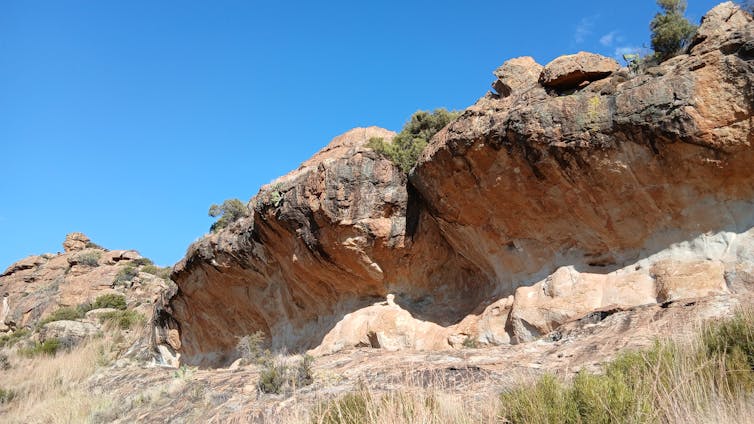 The Mokhali rock shelter is the site near Leribe where the San painted a possible dinosaur footprint and some of the oldest known dinosaur reconstructions.
Julien Benoit, Author provided (no reuse)
The Mokhali rock shelter is the site near Leribe where the San painted a possible dinosaur footprint and some of the oldest known dinosaur reconstructions.
Julien Benoit, Author provided (no reuse)
His notes show that the roots of awareness and interpretation of fossils in southern Africa predate European expeditions and reach into the deep sense of place held by the people living among these fossils since generations. Their interpretations were not “quaint myths” but sophisticated observations shaped by centuries of engagement with the land.
Acknowledging this enriches the scientific record, broadens our understanding of early palaeontology, and honours the contributions of communities whose insights led to important discoveries. Ellenberger has left us an empowering and inspiring legacy for the new generation of southern African palaeontologists.
- Archaeology
- Dinosaurs
- Fossils
- Palaeontology
- Folklore
- Rock art
- Indigenous knowledge
- San
- Lesotho
- Missionaries
- Animal tracking
- Fossil tracks
- African history + heritage
Events
Jobs
-
 Senior Lecturer, Educational Leadership
-
Respect and Safety Project Manager
-
Associate Dean, School of Information Technology and Creative Computing | SAE University College
-
Senior Lecturer, Clinical Psychology
-
University Lecturer in Early Childhood Education
 Senior Lecturer, Educational Leadership
 Respect and Safety Project Manager
 Associate Dean, School of Information Technology and Creative Computing | SAE University College
 Senior Lecturer, Clinical Psychology
 University Lecturer in Early Childhood Education
- Editorial Policies
- Community standards
- Republishing guidelines
- Analytics
- Our feeds
- Get newsletter
- Who we are
- Our charter
- Our team
- Partners and funders
- Resource for media
- Contact us
-
-
-
-
Copyright © 2010–2025, The Conversation