
- Home
Edition
Africa Australia Brasil Canada Canada (français) España Europe France Global Indonesia New Zealand United Kingdom United States Edition:
Global
Edition:
Global
- Africa
- Australia
- Brasil
- Canada
- Canada (français)
- España
- Europe
- France
- Indonesia
- New Zealand
- United Kingdom
- United States
Academic rigour, journalistic flair
 Protesters gather outside Prime Minister Sanae Takaichi’s office in Tokyo on Nov. 21, 2025 to demonstrate against her remarks about Taiwan.
(AP Photo/Louise Delmotte)
War of words between China and Japan is fuelling real tension in the Asia-Pacific region
Published: December 9, 2025 2.00pm GMT
Kuan-Wei Chen, McGill University, Bond University
Protesters gather outside Prime Minister Sanae Takaichi’s office in Tokyo on Nov. 21, 2025 to demonstrate against her remarks about Taiwan.
(AP Photo/Louise Delmotte)
War of words between China and Japan is fuelling real tension in the Asia-Pacific region
Published: December 9, 2025 2.00pm GMT
Kuan-Wei Chen, McGill University, Bond University
Author
-
 Kuan-Wei Chen
Researcher, Air and Space Law, McGill University; Bond University
Disclosure statement
Kuan-Wei Chen is the recipient of a Australian Government Research Training Program scholarship.
Partners

McGill University provides funding as a member of The Conversation CA.
McGill University provides funding as a member of The Conversation CA-FR.
Bond University provides funding as a member of The Conversation AU.
View all partners
DOI
https://doi.org/10.64628/AAM.9ppx7rwpw
https://theconversation.com/war-of-words-between-china-and-japan-is-fuelling-real-tension-in-the-asia-pacific-region-270434 https://theconversation.com/war-of-words-between-china-and-japan-is-fuelling-real-tension-in-the-asia-pacific-region-270434 Link copied Share articleShare article
Copy link Email Bluesky Facebook WhatsApp Messenger LinkedIn X (Twitter)Print article
In a now deleted social media post, the Consul General of the People’s Republic of China to the Japanese city of Osaka recently threatened to “cut off” Japanese Prime Minister Sanae Takaichi’s “filthy head.”
This graphic threat was in response to Takaichi’s suggestion that Japan’s Self-Defense Forces may exercise the right of collective self-defence and become involved in the event of a Chinese attack on Taiwan.
China has called on Takaichi to retract her “erroneous remarks.”
The Chinese outrage is apparently intensifying after Chinese military planes were accused of locking their radar on Japanese fighter jets near the Okinawa islands. China also imposed a ban on Japanese seafood imports.
China’s response has political and nationalistic undertones. China views Taiwan as an “inalienable part” of its territory, a reminder of the “century of humiliation” when the [island was ceded by Imperial China to Japan and became a Japanese colony in 1895].
A matter of history — and law
Even after the Second World War ended, sovereignty over Taiwan was never formally settled. China believes Taiwan must be “reunified” with the motherland, if necessary by force.
The number and intensity of Chinese military drills aimed at intimidating Taiwan have significantly increased in recent years. Chinese leader Xi Jinping has reportedly begun mobilizing the People’s Liberation Army for an invasion of Taiwan by 2027.
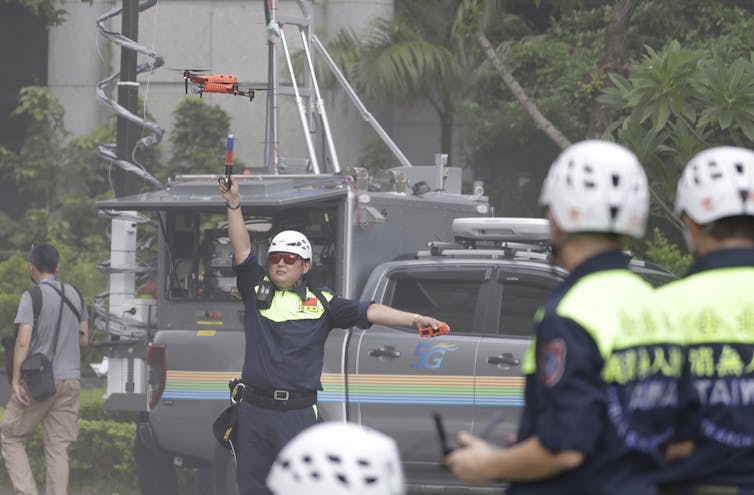 A drone crew operates a drone during an air raid drill in Taipei, Taiwan, in July 2025 as the island carried out large-scale urban resilience drills designed to strengthen its preparedness in the face of mounting tensions with China.
(AP Photo/Chiang Ying-ying)
A drone crew operates a drone during an air raid drill in Taipei, Taiwan, in July 2025 as the island carried out large-scale urban resilience drills designed to strengthen its preparedness in the face of mounting tensions with China.
(AP Photo/Chiang Ying-ying)
Taiwan’s status is complicated under international law. While it has a functioning government, population and defined territory — all necessary elements of statehood — much of the world does not officially recognize Taiwan as a state.
Most countries, including Canada and the United States, engage with Taiwan in a non-official capacity and simply “acknowledge” China’s insistence that Taiwan is part of China.
This respect paid to China is a matter of geopolitics and strategic ambiguity likely due to China’s global economic and political clout, and has little foundation in law.
International resolutions, declarations
China often asserts the 1943 Cairo Declaration as the legal basis for its claim over Taiwan. However, this unsigned media communiqué lacks legal force under international law, something pointed out by British Prime Minister Winston Churchill in 1955.
At the outbreak of the Korean War, U.S. President Harry Truman stated unequivocally that the “determination of the future status of (Taiwan) must await the restoration of security in the Pacific, a peace settlement with Japan or consideration by the United Nations.”
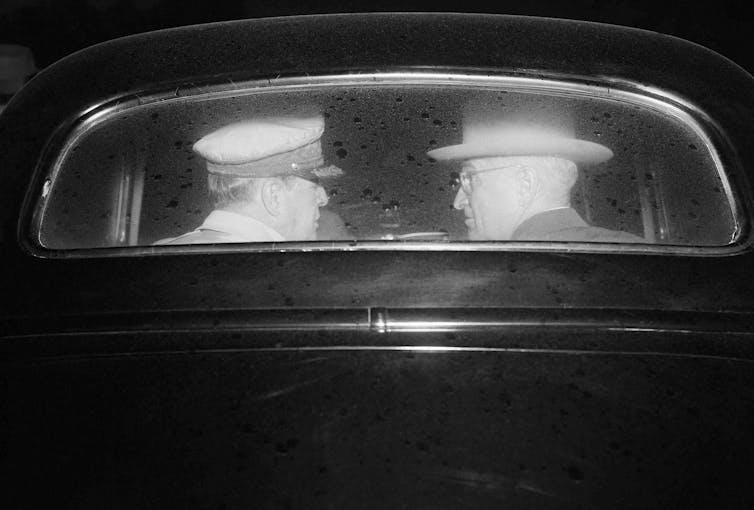 This 1950 photo shows Gen. Douglas MacArthur, left, and U.S. President Harry Truman in an automobile during a meeting to discuss the Korean War on Wake Island in the North Pacific.
(AP Photo)
This 1950 photo shows Gen. Douglas MacArthur, left, and U.S. President Harry Truman in an automobile during a meeting to discuss the Korean War on Wake Island in the North Pacific.
(AP Photo)
The 1951 Treaty of San Francisco, which ended the war between Japan and the Allied powers, is a legally binding treaty. While Japan renounced “all right, title and claim” to Taiwan, there was no mention of the People’s Republic of China — established only two years earlier — in terms of Taiwanese sovereignty.
The United Nations has never considered, let alone decided upon, the issue of sovereignty over Taiwan. China often cites the UN’s General Assembly Resolution 2758 in 1971 as another legal basis for its assertion of sovereignty over Taiwan. But that resolution only addresses the status of the People’s Republic of China as the legitimate representative of China and makes no mention of Taiwan.
The European Parliament and the parliaments of Australia, the Netherlands, as well as U.S. congress, have openly opposed China’s distortion of the UN resolution and attempts to exert undue influence over international organizations for political ends.
Japan-Taiwan proximity
Takaichi’s remarks are simply a reiteration of the late Japanese Prime Minister Shinzo Abe’s remarks that “a Taiwan emergency is a Japan emergency (台湾有事は日本有事).”
 Japanese Prime Minister Sanae Takaichi speaks during a news conference after the South Korea Asia-Pacific Economic Cooperation (APEC) Summit in Gyeongju, South Korea, in November 2025.
(AP Photo/Ahn Young-joon)
Japanese Prime Minister Sanae Takaichi speaks during a news conference after the South Korea Asia-Pacific Economic Cooperation (APEC) Summit in Gyeongju, South Korea, in November 2025.
(AP Photo/Ahn Young-joon)
This is no surprise since, at their closest point, Japan and Taiwan are just over 100 kilometres apart. Japan’s deployment of anti-air missiles on the Okinawa prefecture’s Yonaguni Island and long-range anti-ship missiles at the mouth of the Miyako Strait are clearly aimed at countering a potential Chinese offensive.
The site of the largest American Air Force base in East Asia just a 90-minute flight from Taiwan, and is similarly already gearing up for a potential Chinese missile attack amid rising tensions.
Read more: Why a row over military bases on Okinawa spells trouble for US-Japan relations
Taiwan itself is situated at the crossroads of vital maritime and aviation routes, and manufactures more than 70 per cent of the world’s microchips.
If China opts to blockade or attack Taiwan, it will severely impact the world economy since a fifth of global maritime trade, valued at $2.5 trillion, transits through the Taiwan Strait.
It’s in no one but China’s interests if the Chinese mount an attack, and certainly it’s not the will of the 23 million inhabitants of the independent island nation who enjoy some of the highest levels of political and civil liberties in the world.
The U.S. continues to bolster Taiwan’s defence to deter a Chinese attack since Taiwan’s security is pivotal to America’s strategic standing in the Asia-Pacific region and the world.
 A tourist poses for photos near turbines along the Taiwan Strait in Pingtan, in eastern China’s Fujian province, in August 2022.
(AP Photo/Ng Han Guan)
A tourist poses for photos near turbines along the Taiwan Strait in Pingtan, in eastern China’s Fujian province, in August 2022.
(AP Photo/Ng Han Guan)
Global peace and security
With great power comes great responsibility, and this is true for all states. Threats of invasion, the use of force and non-peaceful means of settling disputes are all prohibited under international law. Undiplomatic rhetoric and distortions of history and the law is also detrimental to peace.
If Taiwan truly is a part of China, then there would be no need for an invasion or threats to “crush” any foreign interference. Through its wolf-warrior diplomacy and shows of force, China is in effect globalizing the Taiwan issue.
As the recent G7 statement states, the international community has “an interest in the preservation of peace and stability across the Taiwan Strait” as China’s military drills and threats of war jeopardize “global security and prosperity.”
In a world beset by conflict in the Middle East and an enduring war in Ukraine, tensions are again heating up in East Asia. Will cooler heads prevail?
- Taiwan
- Xi Jinping
- Pacific Rim
- Listen to this article
- Sanae Takaichi
- Asia-Pacific
Events
Jobs
-
 Senior Lecturer, Educational Leadership
-
Respect and Safety Project Manager
-
Associate Dean, School of Information Technology and Creative Computing | SAE University College
-
Senior Lecturer, Clinical Psychology
-
University Lecturer in Early Childhood Education
 Senior Lecturer, Educational Leadership
 Respect and Safety Project Manager
 Associate Dean, School of Information Technology and Creative Computing | SAE University College
 Senior Lecturer, Clinical Psychology
 University Lecturer in Early Childhood Education
- Editorial Policies
- Community standards
- Republishing guidelines
- Analytics
- Our feeds
- Get newsletter
- Who we are
- Our charter
- Our team
- Partners and funders
- Resource for media
- Contact us
-
-
-
-
Copyright © 2010–2025, The Conversation