
- Home
Edition
Africa Australia Brasil Canada Canada (français) España Europe France Global Indonesia New Zealand United Kingdom United States Edition:
Global
Edition:
Global
- Africa
- Australia
- Brasil
- Canada
- Canada (français)
- España
- Europe
- France
- Indonesia
- New Zealand
- United Kingdom
- United States
Academic rigour, journalistic flair
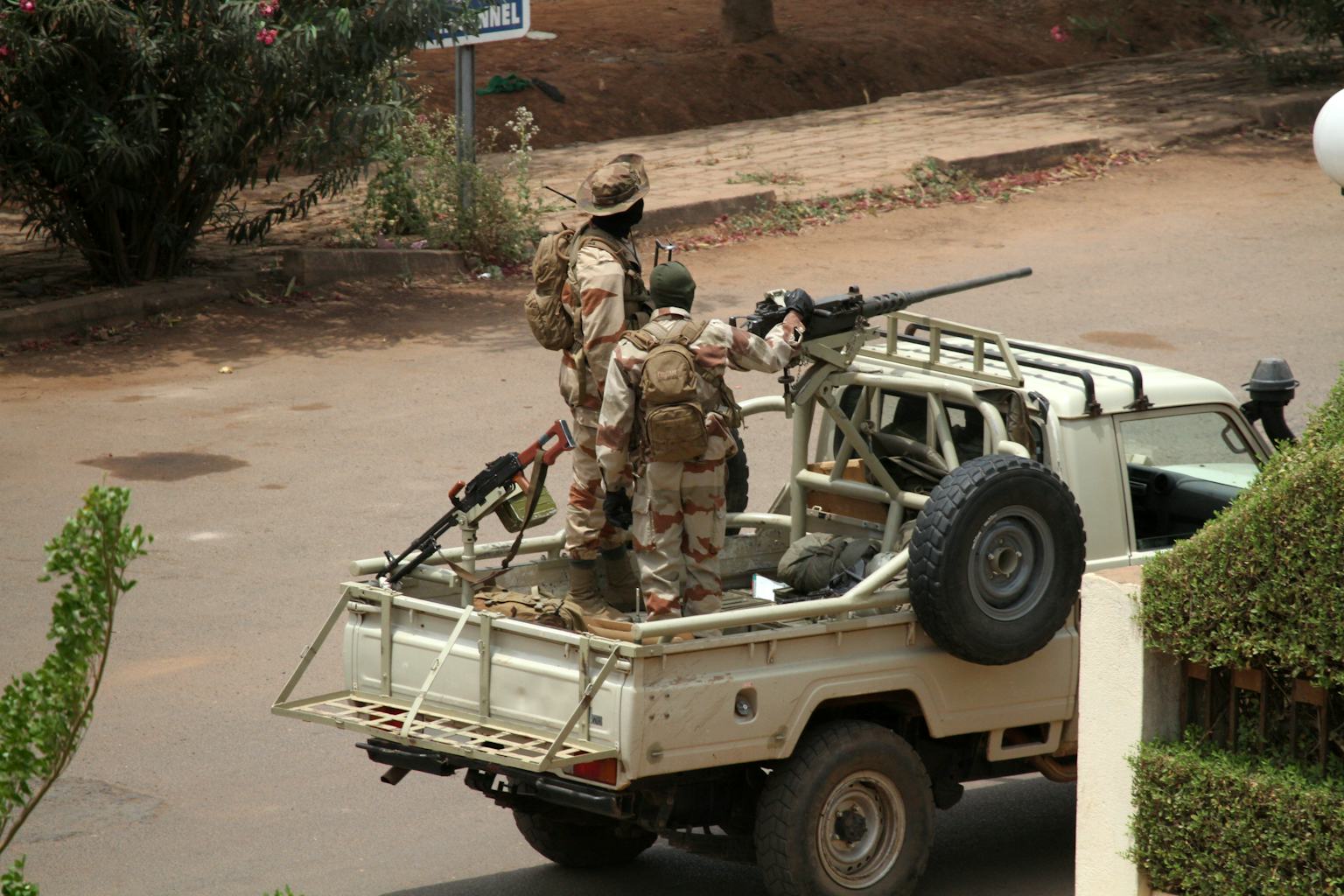 Malian soldiers in Bamako during 2012 coup.
Wikimedia Commons
Coups in Africa: how democratic failings help shape military takeovers – study
Published: December 9, 2025 3.48pm GMT
Ernest Harsch, Columbia University
Malian soldiers in Bamako during 2012 coup.
Wikimedia Commons
Coups in Africa: how democratic failings help shape military takeovers – study
Published: December 9, 2025 3.48pm GMT
Ernest Harsch, Columbia University
Author
-
 Ernest Harsch
Researcher, Institute of African Studies, Columbia University
Disclosure statement
Ernest Harsch does not work for, consult, own shares in or receive funding from any company or organisation that would benefit from this article, and has disclosed no relevant affiliations beyond their academic appointment.
Partners
View all partners
DOI
https://doi.org/10.64628/AAJ.tv3eypn3k
https://theconversation.com/coups-in-africa-how-democratic-failings-help-shape-military-takeovers-study-271565 https://theconversation.com/coups-in-africa-how-democratic-failings-help-shape-military-takeovers-study-271565 Link copied Share articleShare article
Copy link Email Bluesky Facebook WhatsApp Messenger LinkedIn X (Twitter)Print article
Mali, Burkina Faso, Niger, Guinea and Gabon have all suffered regime change in the last five years, led by men in military uniform.
Madagascar and Guinea-Bissau experienced the same fate in 2025. Benin looked to join the list in early December, but the civilian government held onto power – just.
The academic literature on coups in Africa has highlighted a wide range of influences and triggers. These include:
personal and institutional rifts within the armed forces
susceptibility to both elite manipulation and popular pressure
instigation by foreign powers against governments deemed hostile to their interests.
In a recent paper I added a further question: to what extent were democratic failings an element in the coups of the past six years?
I am a journalist and academic who has focused on African political and development issues since the 1970s. Among my most recently published books is Burkina Faso: A History of Power, Protest and Revolution.
In the paper I explored underlying shortcomings of Africa’s democracies as one major factor leading to military seizures. I focused on the recent coups in Mali, Guinea, Burkina Faso, Niger and Gabon.
I selected those cases because each of their takeovers was mounted against an elected civilian government. In some instances, I found, factors other than poor elections were also at play. The juntas in both Burkina Faso and Niger cited political defects of their elected, if somewhat ineffective, governments. But they mainly blamed their predecessors’ failure to put down growing jihadist insurgencies.
Insecurity was also a factor in Mali. But Mali, Guinea and Gabon all had elections commonly perceived to have been rigged or in violation of constitutional term limits. They provoked popular opposition which prompted officers to step in.
My main finding was thus that popular disappointment in elected governments was a prominent element. It established a more favourable context enabling officers to seize power with a measure of popular support.
That finding suggests that in order to better protect democracy in Africa, it is not sufficient to simply condemn military coups (as Africa’s regional institutions, such as the African Union and Economic Community of West African States, are quick to do). African activists, and some policymakers, have urged a step further: denouncing elected leaders who violate democratic rights or rig their systems to hang onto power.
If elected leaders were better held to account, then potential coup makers would lose one of their central justifications.
Problems are bigger than rigged polls
The problems, however, go beyond rigged polls, errant elected leaders, and violated constitutions. Many African governments, whether they are democratic or not, have great difficulty meeting citizens’ expectations, especially for improvements in their daily lives.
The deeper structural weaknesses of African states further contribute to hampering effective governance. As Ugandan anthropologist Mahmood Mamdani, Kenyan political scholar Ken Ochieng’ Opalo, and other African scholars have pointed out, those shortcomings include the externally oriented and fragmentary nature of the states inherited from colonial rule. These exclude many citizens from active political engagement and ensure government by unaccountable elites.
In particular, a neoliberal model of democracy has been widely adopted in Africa since the 1990s. That model insists that democracy be tethered to pro-market economic policies and greatly limit the size and activities of African states. That in turn hinders the ability of even well-elected governments to provide their citizens with security and services.
Read more: South African protesters echo a global cry: democracy isn't making people's lives better
Conducting elections while continuing to subject African economies to the economic policy direction of the International Monetary Fund and World Bank has left them with a “choiceless democracy,” as Malawian economist Thandika Mkandawire termed it. That is, while voters may sometimes be able to change top leaders, they cannot alter basic economic policies. Such policies generally favour austerity and cutbacks over delivering jobs, education and healthcare.
So in addition to improving the quality of democratic systems on the continent, “coup proofing” African states will also require giving greater scope to popular input into real decision making, in both the political and economic spheres.
That will depend primarily on Africans themselves fighting for the democracies they want. Clearing the way for them means ending the all-too-common repression of street mobilisations and alternative views that displease the ruling elites.
Support for democracy
There may be general unhappiness with the flaws of Africa’s electoral systems. Surveys nevertheless demonstrate continued strong support for the ideals of democracy. Many ordinary Africans, moreover, are mobilising in various ways to advance their own conceptions of democratic practice.
For example, when the Macky Sall government in Senegal used repression and unconstitutional manoeuvres to try to prolong his tenure, tens of thousands mobilised in the streets in 2023-24 to block him and force an election that brought radical young oppositionists to power.
In Sudan, the community resistance committees that mobilised massively against the country’s military elites outlined an alternative vision of a people’s democracy encompassing national elections, decentralised local assemblies, and participatory citizen engagement.
Read more: Africans want consensual democracy – why is that reality so hard to accept?
Findings by the Afrobarometer research network, which has repeatedly polled tens of thousands of African citizens, provide solid grounds for hope. Surveys in 39 countries between 2021 and 2023 show that 66% of respondents still strongly preferred democracy to any alternative form of government.
For anyone committed to a democratic future for Africa, that is something to build on.
- Madagascar
- African Union (AU)
- Afrobarometer survey
- Guinea Bissau
- Economic Community of West African States (ECOWAS)
- Africa democracy
- Neo-liberal
- Gabon coup
- Africa coups
- Mali coup
- Guinea coup
- Burkina Faso coup
- Niger coup
- Alliance of Sahelian States
Events
Jobs
-
 Senior Lecturer, Educational Leadership
-
Respect and Safety Project Manager
-
Associate Dean, School of Information Technology and Creative Computing | SAE University College
-
Senior Lecturer, Clinical Psychology
-
University Lecturer in Early Childhood Education
 Senior Lecturer, Educational Leadership
 Respect and Safety Project Manager
 Associate Dean, School of Information Technology and Creative Computing | SAE University College
 Senior Lecturer, Clinical Psychology
 University Lecturer in Early Childhood Education
- Editorial Policies
- Community standards
- Republishing guidelines
- Analytics
- Our feeds
- Get newsletter
- Who we are
- Our charter
- Our team
- Partners and funders
- Resource for media
- Contact us
-
-
-
-
Copyright © 2010–2025, The Conversation