
- Home
Edition
Africa Australia Brasil Canada Canada (français) España Europe France Global Indonesia New Zealand United Kingdom United States Edition:
Global
Edition:
Global
- Africa
- Australia
- Brasil
- Canada
- Canada (français)
- España
- Europe
- France
- Indonesia
- New Zealand
- United Kingdom
- United States
Academic rigour, journalistic flair
 Homes like these, near Achiltibuie, in the Scottish Highlands, are lovely – but can’t be scaled up.
oceanwhisper / shutterstock
Why Grand Designs-style eco-homes aren’t a good blueprint for sustainable living
Published: December 9, 2025 5.21pm GMT
Alan Collins, Nottingham Trent University
Homes like these, near Achiltibuie, in the Scottish Highlands, are lovely – but can’t be scaled up.
oceanwhisper / shutterstock
Why Grand Designs-style eco-homes aren’t a good blueprint for sustainable living
Published: December 9, 2025 5.21pm GMT
Alan Collins, Nottingham Trent University
Author
-
 Alan Collins
Professor of Economics and Public Policy, Nottingham Trent University
Disclosure statement
Alan Collins is a very passive member of the Labour Party
Partners

Nottingham Trent University provides funding as a member of The Conversation UK.
View all partners
DOI
https://doi.org/10.64628/AB.x7nhue535
https://theconversation.com/why-grand-designs-style-eco-homes-arent-a-good-blueprint-for-sustainable-living-268751 https://theconversation.com/why-grand-designs-style-eco-homes-arent-a-good-blueprint-for-sustainable-living-268751 Link copied Share articleShare article
Copy link Email Bluesky Facebook WhatsApp Messenger LinkedIn X (Twitter)Print article
A family builds an off-grid home in rural Wales. TV celebrates it as a blueprint for net-zero living. But what if this vision of sustainability simply doesn’t scale up?
Television shows such as Channel 4’s Grand Designs have long celebrated ambitious one-off homebuilding projects. These programmes often frame bespoke rural housing as a model of sustainable living.
With large audiences, they wield real influence over what viewers imagine an environmentally sustainable lifestyle looks like. But the reality behind many of these supposedly “eco” homes is far more complicated.
The BBC recently explored one such case in Wales, where a family secured planning permission under the Welsh government’s One Planet Development policy. Introduced in 2012, the policy allows zero-carbon homes to be constructed on land where conventional buildings would not be permitted. In return, residents must demonstrate they can provide their own energy and water and derive a basic income from the surrounding land.
At first glance, this all seems a laudable and well-meaning attempt to encourage net-zero living. Yet projects like these raise deeper questions about sustainability, fairness and what it means for a society as a whole to be environmentally responsible.
We can’t all live in rural eco-homes
The first issue is scalability. Rural “eco-homestead” living can appear green at the level of a single household. But how many of these homes, each taking up considerable land, could be built in the Welsh countryside – or the UK more broadly?
A few might operate as experimental demonstration sites in rural areas, but if that’s the goal then a location in or near urban areas would reach far more people.
These homes are not as self-sufficient as the image of rural idyll suggests. People living there would still own cars, commute to work, send children to school and make regular trips for food, healthcare and to socialise. Multiply these car trips over many such developments and their environmental footprint would undermine the very rationale used to approve the developments.
This is the opposite of the 15-minute city ideal. Dispersed rural living simply cannot match the efficiency of compact urban living.
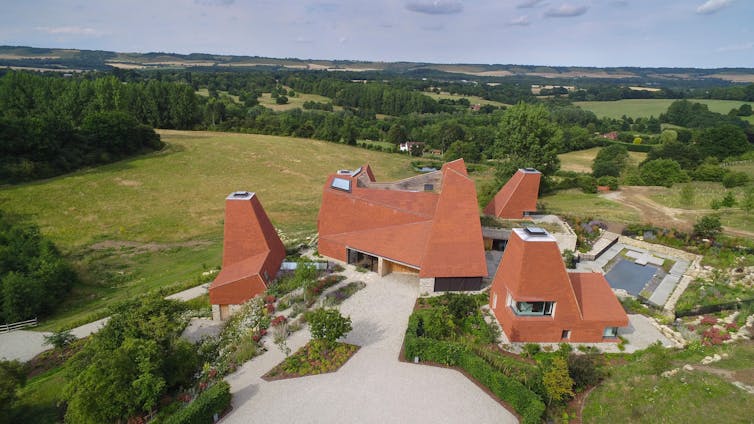 Caring Wood featured on Grand Designs and won RIBA House Of The Year in 2017. Inspired by traditional ‘oast houses’ for drying hops, judges praised its ‘use of clean green technologies’.
Phil Broom / Alamy
Caring Wood featured on Grand Designs and won RIBA House Of The Year in 2017. Inspired by traditional ‘oast houses’ for drying hops, judges praised its ‘use of clean green technologies’.
Phil Broom / Alamy
Academic research in economics, geography and planning has long showed that cities generate “agglomeration economies”: the practical benefits of living around lots of other people means schools, healthcare, public transport and other services tend to be more efficient than in the countryside. This makes urban living far more sustainable for large populations and is one reason rural eco-homes are completely unsustainable as a means of meeting genuine housing needs.
Fair and inclusive
The second issue concerns fairness and access. If permission for remote single household plots is to be restricted in number, then that cap should be explicit and justified. At present, it is neither.
The result is that only the wealthy – people able to acquire attractive rural land, navigate the planning system and fund bespoke eco-builds – can pursue this lifestyle. This risks breeding resentment, especially if access to attractive countryside or forest locations becomes effectively privatised by those who can afford large, low-density housing.
 Lark Rise in Buckinghamshire was designed to generate more electricity than it consumes.
Phil Broom / Alamy
Lark Rise in Buckinghamshire was designed to generate more electricity than it consumes.
Phil Broom / Alamy
This has broader political implications. As the climate crisis intensifies, public support for environmental action depends on perceptions of fairness. If “sustainable living” is seen as something the wealthy perform in idyllic rural retreats while ultimately relying on urban services and infrastructure, that narrative becomes exclusionary and demotivating. It signals that meaningful environmental responsibility isn’t possible for the majority living in towns and cities. That helps create a form of socio-environmental separation: green lifestyles for a wealthy minority, higher environmental costs for everyone else.
Programmes like Grand Designs play an important role in shaping expectations for green living and dream “forever home” residential building projects. Their enthusiasm for remote, self-built eco-homes gives viewers the impression that sustainability is achieved through architectural daring and a retreat from urban life. These stories generate a warm glow for the featured household, but they don’t represent a realistic way to collectively tackle the climate and environment crises.
The most effective solutions are more mundane, and far less televisual. For instance, better roof insulation or the replacement of old boilers could be rolled out for millions of homes and would have a far greater environmental impact. Such policies lack the drama of building a fancy off-grid smallholding, but they are scalable, accessible for all and genuinely aligned with climate goals.

Don’t have time to read about climate change as much as you’d like? Get a weekly roundup in your inbox instead. Every Wednesday, The Conversation’s environment editor writes Imagine, a short email that goes a little deeper into just one climate issue. Join the 47,000+ readers who’ve subscribed so far.
- Sustainability
- Architecture
- eco-housing
- Off-grid
- Give me perspective
Events
Jobs
-
 Senior Lecturer, Educational Leadership
-
Respect and Safety Project Manager
-
Associate Dean, School of Information Technology and Creative Computing | SAE University College
-
Senior Lecturer, Clinical Psychology
-
University Lecturer in Early Childhood Education
 Senior Lecturer, Educational Leadership
 Respect and Safety Project Manager
 Associate Dean, School of Information Technology and Creative Computing | SAE University College
 Senior Lecturer, Clinical Psychology
 University Lecturer in Early Childhood Education
- Editorial Policies
- Community standards
- Republishing guidelines
- Analytics
- Our feeds
- Get newsletter
- Who we are
- Our charter
- Our team
- Partners and funders
- Resource for media
- Contact us
-
-
-
-
Copyright © 2010–2025, The Conversation